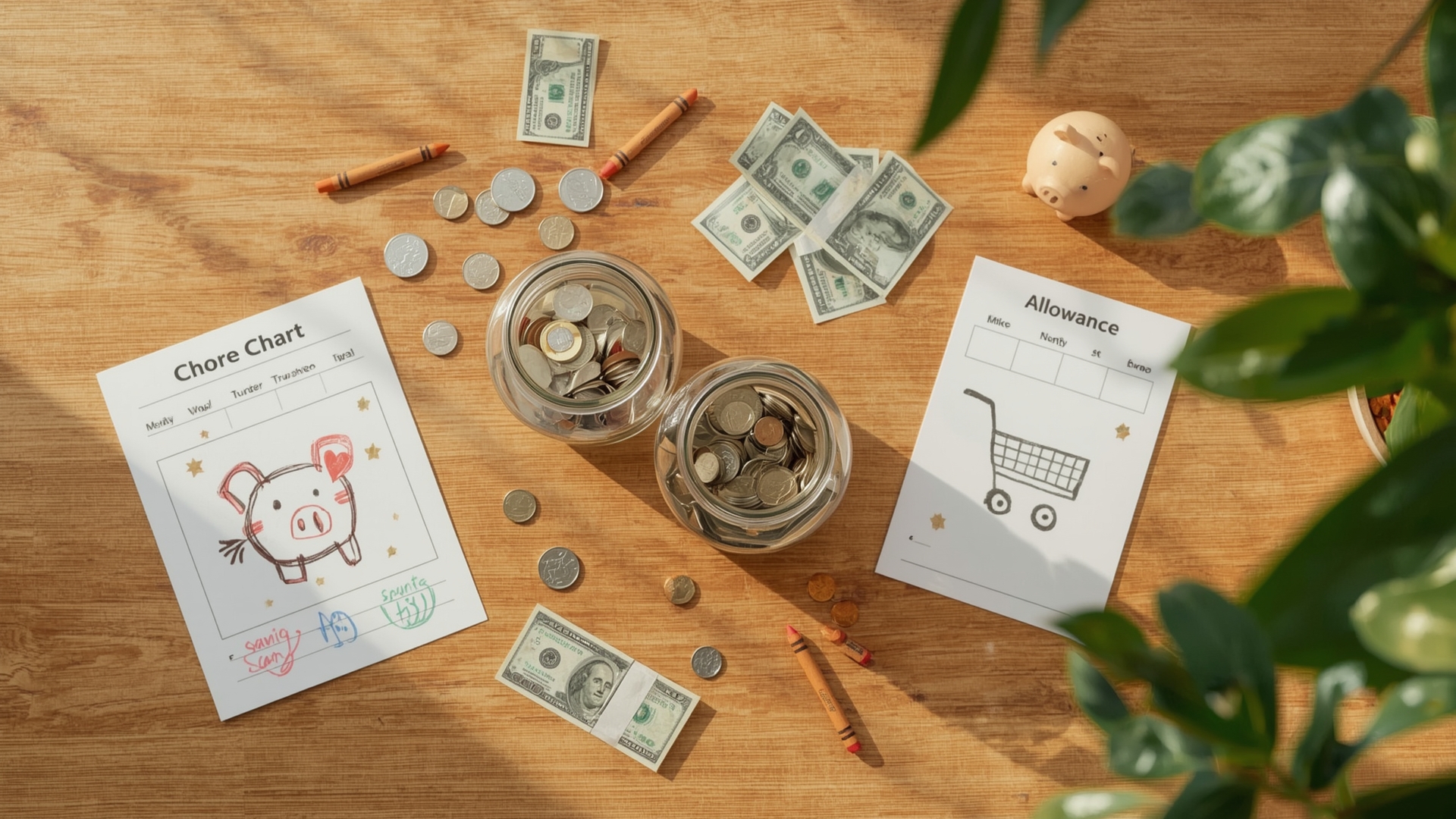
Most kids spend money before they learn to earn it. An allowance system changes that. It gives children a structured way to earn, save, and spend money — and builds money habits that stick into adulthood. The key is choosing a model that fits your family and your child’s age.
There are three main allowance models: flat-rate (a set amount each week), commission-based (pay per task completed), and hybrid (a small base amount plus earning opportunities). Each works differently depending on your goals and your child’s developmental stage.
Key Takeaways
- Three models to choose from: flat-rate, commission-based, and hybrid — each fits different parenting philosophies.
- Age matters: Kids ages 4 to 6 start with coins and simple tasks; teens handle multi-category budgets and bigger goals.
- The commission model teaches cause and effect: earn more by doing more.
- The flat-rate model teaches budgeting: manage a fixed amount across spending, saving, and giving.
- Consistency beats amount: a small, reliable allowance teaches more than a large, irregular one.
- Three-jar or three-account systems are the most effective way to teach spend, save, and give habits from the start.
What Is a Kids Allowance System?
Quick Answer: A kids allowance system is a structured plan for giving children regular money — either earned through tasks or given as a fixed amount. It teaches budgeting, saving, and financial responsibility using age-appropriate earning structures and clear rules.
An allowance system is not just handing your kid $5 on Saturday. It’s a framework with defined rules: how money is earned (or given), how often it’s paid out, and what the child is expected to do with it.
Good systems also include a money management method. Most families use a three-category split: spending, saving, and giving. Some use physical jars. Others use separate bank accounts or apps designed for kids.
The system works best when it’s consistent, age-appropriate, and connected to your family’s values around money.
What Are the Main Types of Allowance Systems?

Quick Answer: The three main types are flat-rate (fixed weekly amount, no chore requirement), commission-based (earn per task completed), and hybrid (small base amount plus optional earning tasks). Each model teaches different financial skills.
Flat-Rate Allowance
With flat-rate, your child gets a set amount each week regardless of what they do. The goal is not to pay for chores — it’s to give kids money to practice budgeting with.
This model works well if you believe household chores are a family responsibility, not a service. Kids learn to manage a fixed income, which mirrors how adults experience a salary.
The downside: some children lose motivation to do extra around the house because there’s no financial incentive.
Commission-Based Allowance
In a commission model, your child earns a set amount per task. No task, no pay. More tasks, more money. This is sometimes called a “pay-per-chore” system.
It directly links effort to income. Kids who want more money learn to do more work — a pattern that mirrors real employment. It’s especially motivating for middle-grade children (ages 8 to 12).
The limitation: some tasks get skipped if a child doesn’t need money that week, which can create inconsistency in household routines.
Hybrid Allowance
The hybrid model combines both approaches. A child gets a small base allowance for being part of the family. On top of that, they can earn extra by completing optional tasks from an “earning menu.”
This gives kids a financial floor while still rewarding initiative. It works well for families who want consistent household contribution AND want to teach entrepreneurial thinking.
Many financial educators recommend this model for children ages 8 and older.
How Much Allowance Should You Give by Age?
Quick Answer: A common guideline is $0.50 to $1 per week per year of age. A 6-year-old might get $3 to $6 per week. A 12-year-old, $6 to $12. Adjust based on your local cost of living and what expenses the child is expected to cover.
| Age Range | Suggested Weekly Amount | Model Fit | Child Covers | Pay Frequency |
|---|---|---|---|---|
| 4 to 6 years | $2 to $4 | Flat-rate | Small treats, toys under $5 | Weekly |
| 7 to 9 years | $4 to $7 | Flat-rate or hybrid | Snacks, small purchases, part of gifts | Weekly |
| 10 to 12 years | $7 to $12 | Commission or hybrid | Entertainment, games, hobby supplies | Weekly or biweekly |
| 13 to 15 years | $15 to $25 | Hybrid or commission | Clothing budget, social outings, subscriptions | Biweekly |
| 16 to 18 years | $25 to $50 or negotiated | Hybrid or earned income | Gas, clothes, entertainment, savings goals | Biweekly or monthly |
These ranges are guidelines, not rules. The right amount depends on what expenses your child is expected to manage from their allowance. A teen who buys their own school lunches needs more than one who doesn’t.
What Age Should You Start an Allowance?
Quick Answer: Most children are ready for a basic allowance between ages 4 and 6, once they can count coins and understand that money is exchanged for things. Starting early builds habits — even a $2 weekly allowance teaches the spend-save-give concept.
At age 4, a child can understand that a coin goes in a piggy bank. That’s enough to start. You don’t need complex systems yet. A clear jar labeled “save” and one labeled “spend” is sufficient at this stage.
By age 6 to 7, most children can handle basic math and simple chore charts. This is the right time to introduce a more structured system with a clear earning or distribution schedule.
Waiting until age 10 or 12 to start means missing years of habit-building during a critical window of development.
How Does the Commission-Based Allowance Work in Practice?
Quick Answer: You create a task list with assigned dollar values. The child completes tasks and tracks them on a chore chart. At payout time, you tally completed tasks and pay out. Tasks range from $0.25 for small jobs to $3 to $5 for bigger ones.
Building a Commission Task List
Start by separating two types of tasks: baseline expectations and earning opportunities. Baseline tasks (keeping their room tidy, brushing teeth) are not paid. Earning tasks are optional extras the child can choose to complete.
This distinction matters. Paying for every basic task can create a child who won’t do anything without payment. Earning tasks teach initiative without replacing family responsibility.
| Task | Age Range | Earning Rate | Frequency Available | Task Type |
|---|---|---|---|---|
| Set the dinner table | 5 to 8 | $0.25 per time | Daily | Earning |
| Fold and put away laundry | 7 to 12 | $0.50 per load | 2 to 3x per week | Earning |
| Vacuum a room | 8 to 14 | $1.00 per room | Weekly | Earning |
| Wash the car | 10 to 16 | $3.00 to $5.00 | Monthly | Earning |
| Mow the lawn | 12 to 17 | $5.00 to $10.00 | Weekly (seasonal) | Earning |
| Babysit younger sibling | 14 to 17 | $5.00 to $15.00 per session | As needed | Earning |
Tracking Commission Earnings
Kids need a visual record. A simple tally sheet, a chore chart with checkboxes, or a whiteboard in the kitchen works well. This reduces disputes at payout time and gives kids a sense of progress.
For older children, a simple spreadsheet or a kids’ banking app adds a layer of real-world financial literacy. They see income accumulating, which builds motivation.
How Should Kids Divide Their Allowance?

Quick Answer: The most common split is 70% spending, 20% saving, 10% giving. Some families prefer equal thirds. The exact percentages matter less than the habit of dividing every dollar received into categories before spending anything.
The Three-Jar System Explained
The three-jar system is simple. You get three jars or containers and label them: Spend, Save, and Give. Every time your child receives money, they split it before touching any of it.
Physical jars work best for younger children (ages 4 to 10) because they can see and touch the money. The visual of jars filling up is more motivating than numbers on a screen at this age.
Upgrading to a Three-Account System
For teens, physical jars can feel childish. A better option is a youth checking account, a savings account, and a giving fund. Many credit unions and banks offer teen accounts with no minimum balance.
Some families use apps like Greenlight, GoHenry, or BusyKid to manage digital allowances with built-in spending, saving, and giving categories. These also give parents visibility into spending without micromanaging.
| App | Monthly Cost | Age Range | Chore Tracking | Invest Feature | Debit Card Included |
|---|---|---|---|---|---|
| Greenlight | $5.99 to $14.98 | 6 to 18 | Yes | Yes (higher tiers) | Yes |
| GoHenry | $4.99 per child | 6 to 18 | Yes | No | Yes |
| BusyKid | $3.99/month | 5 to 17 | Yes | Yes | Yes (paid add-on) |
| FamZoo | $5.99/month | Any age | Yes | No | Yes |
| Current (Teen) | Free | 13 to 17 | No | No | Yes |
What Chores Are Age-Appropriate for an Earning System?
Quick Answer: Chores should match the child’s physical ability and attention span. Ages 4 to 6 handle simple tasks like feeding pets or picking up toys. Ages 10 and up can manage laundry, vacuuming, and meal prep tasks. Stretch tasks that build new skills motivate older kids.
Age-by-Age Chore Breakdown
| Age | Suitable Tasks | Baseline vs. Earning | Supervision Needed |
|---|---|---|---|
| 4 to 5 | Pick up toys, feed pets, put dirty clothes in hamper | Mostly baseline | High |
| 6 to 7 | Set/clear table, water plants, make bed, dust low surfaces | Mix of both | Medium |
| 8 to 10 | Empty dishwasher, fold laundry, rake leaves, sweep floors | Mix of both | Low to medium |
| 11 to 13 | Vacuum, mop, clean bathrooms, prepare simple meals | Earning focused | Low |
| 14 to 17 | Lawn care, grocery runs, full meal prep, babysitting | Earning focused | Minimal |
How Do You Keep Kids Motivated With an Allowance System?

Quick Answer: Motivation stays high when kids have a clear savings goal, see their progress visually, and feel the system is fair. Short-term goals (under 4 weeks to reach) work better than long-term ones for children under age 10.
Using Savings Goals to Drive Engagement
Ask your child what they want to save for. It doesn’t have to be big. A $15 toy or a $20 video game is enough to make saving feel real. Write the goal down and post it near their money jars.
When a child can connect their effort to something they want, the system becomes self-motivating. You stop being the enforcer and become the banker.
What to Do When Kids Lose Interest
Loss of interest is common. It usually means one of three things: the goal feels too far away, the tasks feel unfair, or the system has become invisible (nobody’s talking about it).
Refresh the earning menu every few months with new tasks. Add a bonus opportunity for completing a full week of tasks. Or hold a quarterly “money meeting” where the child reports on their savings progress.
How Do You Handle Allowance Mistakes Like Overspending or Losing Money?
Quick Answer: Let natural consequences play out. If a child spends all their money and wants something else, the answer is “you’ll have to earn it.” Resist the urge to bail them out. Running out of money is one of the most valuable financial lessons an allowance can teach.
Overspending is not a failure of the system. It’s the system working. The lesson is only learned if the consequence is real. That means no advances, no loans from parents unless you’ve built a formal “parent bank” into your system with agreed interest and repayment terms.
Losing money is harder because it’s accidental. For young children, a small replacement once is reasonable. After that, the lost money stays lost. That’s the real world.
Should Allowance Be Tied to Grades or Behavior?
Quick Answer: Most child development experts advise against tying allowance to grades or behavior. Doing so can undermine intrinsic motivation — the child’s own drive to do well. Allowance works best when it’s connected to tasks or family contribution, not academic performance.
When grades are tied to money, children may focus on the reward rather than the learning. Research in behavioral psychology shows that external rewards can reduce intrinsic motivation over time — a phenomenon called the “overjustification effect.”
Behavior-based allowance has similar problems. If good behavior earns money, what happens when the money stops? Keep allowance connected to contribution and financial learning, not compliance.
What Common Allowance System Mistakes Should You Avoid?
Quick Answer: The most common mistakes are inconsistent payouts, no money management component, tasks with no clear value, and starting too late. Systems that lack structure fade quickly. The fix is a written plan, a posted chore list, and a regular payout day that never gets skipped.
Starting Without a Written Plan
An allowance system without clear rules falls apart within weeks. Write down the model you’re using, the payout schedule, which tasks are paid, and the spend-save-give split your family uses. Post it where everyone can see it.
Skipping the Money Lesson
Handing over cash without talking about money is a missed opportunity. Even five minutes at payout time — “how much did you save this week? What are you saving for?” — reinforces the habits the system is designed to build.
Changing the Rules Without Warning
Kids need predictability. If you reduce the allowance amount, remove a task from the earning list, or skip a payout, their trust in the system breaks down. Any changes to the system should be announced at least one week ahead and explained clearly.
How Do You Transition from Allowance to Real-World Earning?
Quick Answer: Between ages 14 and 16, many teens are ready to move from household-based earnings to outside jobs, side gigs, or small business ideas. The skills built through a commission-based allowance — showing up, completing tasks, tracking earnings — directly transfer to real employment.
At this stage, parents can shift from managing the system to consulting on it. The teen sets their own savings goals, manages their own budget categories, and starts building credit awareness through secured cards or teen checking accounts.
Some families keep a small base allowance through high school to cover household-related expenses while encouraging outside earning for discretionary spending. This mirrors the experience of a first job — income from multiple sources with real financial responsibility.
Frequently Asked Questions About Kids Allowance Systems
Does giving an allowance spoil children?
Not when the system is structured. Spoiling happens when money is given without expectations. An allowance tied to tasks, money management, and savings goals teaches the opposite — that money is earned and managed, not just received.
What if my child refuses to do chores on a commission system?
That’s their choice — and their consequence. If they don’t work, they don’t earn. Avoid rescuing them by giving money anyway. A week without spending money is a more effective teacher than any lecture about responsibility.
Is a digital allowance app better than physical cash?
For children under 8, physical cash and jars are more effective because they make money tangible. For older kids and teens, apps like Greenlight or FamZoo offer real-world digital banking skills. The best tool is the one your family will actually use consistently.
How do you handle allowance for kids with different ages in the same house?
Use age-appropriate amounts and task lists for each child. Transparency helps — most kids accept different rates when the reasoning is tied to age and responsibility. A family chore board showing each child’s tasks prevents the “that’s not fair” problem.
Should you pay interest on money in a child’s savings jar?
Yes — and many financial educators recommend it. A “parent bank” that pays 5% to 10% monthly interest on saved money teaches compound interest in a hands-on way. It makes saving feel rewarding much faster than a real bank’s interest rate would.
What is the best allowance model for a single-income family?
The commission-based model works well here because there’s no fixed payout obligation. You pay only for work completed. You can also scale earning tasks to your budget by adjusting rates seasonally or by task type, keeping the system sustainable without a set weekly commitment.