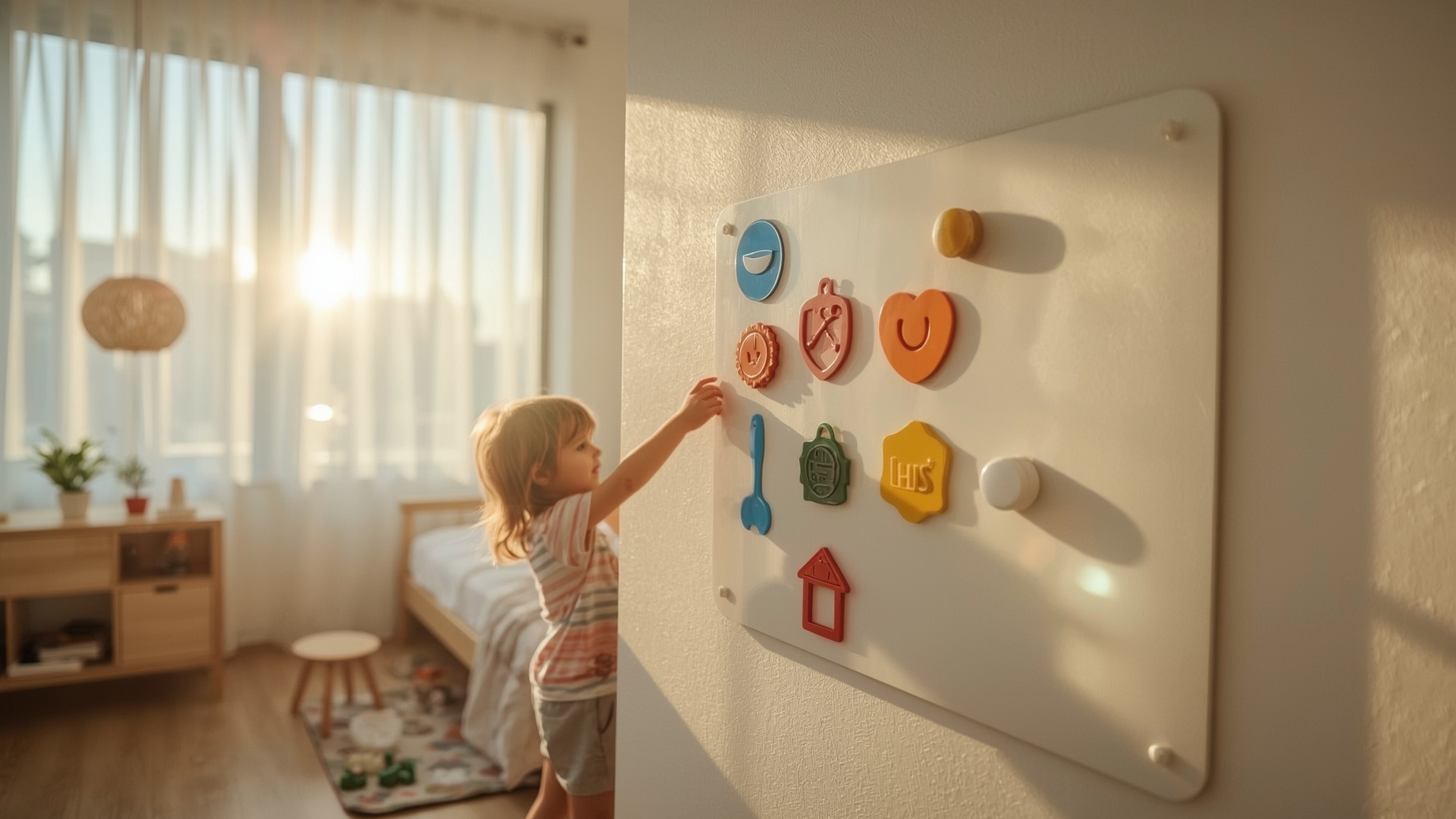
Getting kids to move through their day without constant reminders is something most parents dream about. A kids daily routine chart makes that possible. It takes the daily back-and-forth out of your hands and puts it into a visual system your child can follow on their own.
The difference between a chart that works and one that collects dust comes down to setup. The right structure, the right design for your child’s age, and the right way to introduce it can turn a chaotic morning into a smooth, predictable one.
Key Takeaways
- Routine charts reduce power struggles by shifting authority from parent to schedule.
- Age determines format: picture-based charts for toddlers, checkbox charts for school-age kids, and time-blocked charts for tweens.
- Three core routine blocks cover the full day: morning, after school, and bedtime.
- Consistency beats perfection: a simple chart used daily outperforms a complex one ignored after a week.
- Laminated or magnetic charts last longer and let kids check off tasks with a dry-erase marker.
- Children as young as 2.5 to 3 years old can begin following a simple two-step visual routine.
What Is a Kids Daily Routine Chart and Why Does It Work?

Quick Answer: A kids daily routine chart is a visual tool that lists a child’s daily tasks in order. It works because children thrive on predictability. When expectations are visible and consistent, kids follow through more independently and with less resistance.
Children’s brains are still developing the part that manages planning and impulse control. That part, called the prefrontal cortex, isn’t fully developed until early adulthood. A routine chart acts as an external brain. It offloads the “what do I do next” question so kids can simply follow the steps.
Research in child development consistently shows that predictable daily routines reduce anxiety in children. When kids know what’s coming, they feel safer. That sense of safety leads to better cooperation and fewer meltdowns.
The chart also removes the parent from the equation. Instead of “Mom said to brush your teeth,” the chart says so. This shift reduces parent-child conflict over everyday tasks significantly.
What Age Can Kids Start Using a Routine Chart?
Quick Answer: Kids can start using a simple picture-based routine chart as early as age 2.5 to 3. At that age, limit charts to two or three picture steps. School-age children from ages 5 to 12 can use checkbox or icon-based charts with more steps.
Toddlers (Ages 2 to 4)
Toddlers can follow routines, but they need pictures, not words. Use large, clear images for each task. Limit the chart to three to five steps. Laminated picture cards with velcro strips work well because kids can physically move each card when a task is done.
Focus on bedtime and morning routines first. These two anchors give toddlers the most structure where they need it most.
Preschool and Kindergarten (Ages 4 to 6)
At this age, kids recognize familiar symbols and some words. Charts can include simple labels alongside pictures. Checkboxes or smiley faces to mark completion add an element of pride and accomplishment.
Keep routines to five to eight steps maximum. Adding too many tasks at once overwhelms young kids and kills consistency.
Elementary School Age (Ages 6 to 12)
School-age kids can handle written charts with time cues. They can also help design their own chart, which dramatically increases buy-in. Charts at this stage can cover all three routine blocks: morning, after school, and bedtime.
Checkbox-style or sticker-based tracking works well here. Some kids respond better to earning a visual reward (like filling in a star) than to verbal praise alone.
Tweens (Ages 10 to 13)
Tweens often resist anything that feels “babyish.” Frame charts as time management tools, not rules. Digital apps or a simple whiteboard with time blocks tend to appeal more to this age group.
Let tweens own their schedule. They can set their own wake time and plan homework around activities, with non-negotiable tasks like homework and bedtime as the only fixed points.
What Should a Morning Routine Chart Include?

Quick Answer: A morning routine chart should include wake-up, bathroom hygiene tasks, getting dressed, eating breakfast, packing a bag, and leaving the house. Order tasks from the moment they wake up to the moment they walk out the door.
Morning Routine Tasks by Age Group
| Task | Ages 3 to 5 | Ages 6 to 9 | Ages 10 to 13 |
|---|---|---|---|
| Wake up and get out of bed | With parent help | Independently | Self-managed alarm |
| Use the bathroom | With reminders | Independent | Independent |
| Brush teeth | Parent assists | Independent, 2 min | Independent, 2 min |
| Get dressed | Simple clothes laid out night before | Chooses outfit | Full independence |
| Eat breakfast | Parent prepares | Parent prepares | Can prepare own |
| Pack school bag | Not applicable | With checklist | Fully independent |
| Leave the house by | 7:30 to 8:30 AM | 7:15 to 8:15 AM | 7:00 to 8:00 AM |
How to Make Mornings Run Faster
The biggest morning time-waster is decision-making. Eliminate it the night before. Lay out clothes, pack the school bag, and prep breakfast items before bed. This alone can cut morning preparation time by 10 to 15 minutes.
Assign each task an approximate time so kids develop their own internal clock. “Brush teeth for 2 minutes” is more concrete than “brush teeth.”
What Should an After-School Routine Chart Cover?
Quick Answer: An after-school routine chart should cover arrival home, a snack break, homework time, free play or screen time, and preparation for the next day. Structure this block to balance decompression time with responsibility before dinner.
Kids often come home mentally drained. The transition from school to home needs a short decompression window. Build a 15 to 20 minute snack and rest period into the chart before homework begins.
After-School Routine Block Structure
- Arrive home (10 minutes): Unpack bag, put shoes and jacket away, wash hands.
- Snack and downtime (15 to 20 minutes): Unstructured rest before tasks begin.
- Homework block (30 to 60 minutes): Dedicated, distraction-free study time at a consistent location.
- Chores or household contribution (10 to 15 minutes): One to two age-appropriate tasks.
- Free play or screen time (30 to 60 minutes): Earned after responsibilities are complete.
- Dinner preparation or table setting (10 minutes): Family contribution task.
Placing screen time after responsibilities is a key design decision. It creates a natural reward structure without requiring a separate reward system.
What Does an Effective Bedtime Routine Chart Look Like?

Quick Answer: An effective bedtime routine chart starts 30 to 60 minutes before target sleep time. It includes tidying up, a bath or shower, brushing teeth, putting on pajamas, quiet reading, and lights out. Consistency in timing matters more than the exact tasks.
Recommended Bedtime Windows by Age
| Age Group | Recommended Sleep Amount | Target Bedtime | Routine Start Time |
|---|---|---|---|
| Toddlers (Ages 1 to 3) | 11 to 14 hours | 6:30 to 7:30 PM | 6:00 to 7:00 PM |
| Preschool (Ages 3 to 5) | 10 to 13 hours | 7:00 to 8:00 PM | 6:30 to 7:30 PM |
| School Age (Ages 6 to 12) | 9 to 12 hours | 7:30 to 9:00 PM | 7:00 to 8:30 PM |
| Tweens (Ages 10 to 13) | 8 to 10 hours | 8:30 to 9:30 PM | 8:00 to 9:00 PM |
The Wind-Down Sequence That Works
The bedtime routine chart should signal to the body that sleep is coming. Start by reducing stimulation. Screens off 30 minutes before lights out is the single highest-impact change most families can make.
A bath or shower about 20 to 30 minutes before bed causes a natural drop in body temperature afterward, which makes falling asleep easier. This isn’t just a hygiene task — it’s a biological sleep trigger.
End the chart with the same two or three calming steps every night. Reading in bed, quiet talking, or soft music are all good options. This consistency cues the brain to shift into sleep mode.
How Do You Design a Kids Routine Chart That Kids Actually Use?
Quick Answer: Design a chart with your child’s input, use visuals that match their age, keep it to one page, and place it somewhere visible. Involve kids in choosing colors or pictures. Charts kids help create get used far more consistently than ones handed to them.
Chart Format Options and Best Uses
| Chart Format | Best Age Range | Materials Needed | Durability | Cost Range |
|---|---|---|---|---|
| Picture card velcro board | Ages 2 to 5 | Printed cards, velcro, board | High (reusable daily) | $5 to $15 DIY |
| Laminated checkbox chart | Ages 4 to 10 | Printer, laminator, dry-erase marker | Very high (wipe and reset) | $2 to $8 DIY |
| Magnetic whiteboard chart | Ages 5 to 12 | Whiteboard, magnetic clips | Very high (permanent) | $10 to $30 |
| Printed paper sticker chart | Ages 4 to 9 | Printer, stickers | Low (weekly replacement) | $1 to $3 per week |
| Digital app chart | Ages 8 to 13 | Tablet or phone | Very high | $0 to $10/month |
Where to Display the Chart
Placement matters as much as design. Hang the morning routine chart in the bathroom or bedroom where kids start their day. Put the bedtime chart at eye level in the bedroom. The after-school chart works best in the kitchen or entryway.
If kids can’t see the chart without searching for it, they won’t use it.
What Are the Most Common Mistakes Parents Make with Routine Charts?
Quick Answer: The most common mistakes are making charts too complex, skipping consistency on weekends, setting unrealistic time expectations, and abandoning charts after one rough week. Most charts fail because of implementation, not design.
Seven Mistakes That Kill Routine Charts
- Too many tasks at once: Start with five to seven tasks and add more only after the current ones are habit.
- No visual cues: Words-only charts don’t work for younger children or early readers.
- Inconsistent weekends: Routines only become automatic through daily repetition — including Saturday and Sunday.
- Parent micromanaging: Let the chart do the reminding. Step back and let kids check themselves.
- No child input: Kids reject routines imposed on them. Involve them in the design process.
- Unrealistic time blocks: A 7-year-old cannot get fully ready in 10 minutes. Build in buffer time.
- Giving up after one bad day: It takes 21 to 66 days to build a new habit. Expect early resistance and stay consistent.
How Do You Introduce a Routine Chart to a Resistant Child?
Quick Answer: Introduce the chart as a team project, not a new rule. Let the child pick the design, choose task order where possible, and practice the routine together for the first week. Frame the chart as a tool that gives them more independence, not more control over them.
Timing matters. Don’t launch a new chart during a stressful week or right before school starts. Choose a calm weekend to introduce it and run through the routine together as a practice run.
Make the first week a no-pressure observation period. Praise any task completed independently, even if timing isn’t perfect. The goal for week one is familiarity, not perfection.
Avoid adding consequences for incomplete tasks in the early stages. Reward completion with specific praise: “You got dressed and brushed your teeth without me asking — that’s huge.” Specific feedback works better than generic “good job” praise.
What Makes a Printable Routine Chart Template Effective?
Quick Answer: An effective printable routine chart template is one page, uses readable fonts and clear icons, separates morning, afternoon, and evening blocks, includes a checkbox or tracker column, and is designed to be laminated or reused without reprinting every week.
Must-Have Elements in a Printable Template
- Clear time blocks: Morning, after school, and bedtime as separate sections on the same page.
- Icon or image column: One small visual per task, even for older kids.
- Checkbox or completion column: A spot for daily tracking.
- Child’s name field: Personalization increases ownership.
- Simple, clean design: Avoid cluttered backgrounds that compete with the task list.
- Portrait orientation: Fits standard 8.5 x 11 inch paper and hangs easily on a wall or door.
Printing and Preserving Your Chart
Laminating a printable chart is the most practical way to make it reusable. A standard home laminator costs between $20 and $40. Once laminated, kids can check off tasks with a dry-erase marker and reset the chart each morning with a quick wipe.
Alternatively, slide the printed chart into a clear plastic page protector. It creates the same dry-erase surface without a laminator.
How Do You Adjust a Routine Chart as Kids Grow?
Quick Answer: Review and update your child’s routine chart every three to six months or at major life transitions like a new school year, a move, or a new sibling. Add tasks as independence grows and remove tasks that are now fully automatic habits.
Signs It’s Time to Update the Chart
- Your child completes all tasks without looking at the chart (a habit is fully formed).
- New responsibilities have been added at school or home.
- The current chart isn’t covering a problem area like a consistent after-school meltdown.
- Your child has grown past the chart’s visual style and now finds it babyish.
- A major schedule change has shifted daily timing (new school start time, new extracurricular activity).
How Do Routine Charts Connect to Kids’ Independence and Confidence?
Quick Answer: Routine charts build independence because they shift task initiation from parent to child. Each completed task builds a small sense of accomplishment. Over time, that self-directed success translates into greater self-confidence and reduced reliance on adult prompting.
When a child can look at a chart, complete a task, and check it off on their own, they’ve exercised executive function. That’s the mental skill of planning, initiating, and completing a goal. Routine charts are one of the most accessible ways to practice this skill at home.
The long-term payoff goes beyond clean teeth and packed bags. Kids who grow up with consistent routines tend to develop better time management skills and self-regulation as teens. The chart is a starting point for those bigger life skills.
EAV Summary: Kids Daily Routine Chart at a Glance
| Entity | Attribute | Value |
|---|---|---|
| Morning Routine Chart | Recommended task count | 5 to 8 tasks |
| Morning Routine Chart | Average duration | 30 to 60 minutes |
| Bedtime Routine Chart | Start time before sleep | 30 to 60 minutes |
| Bedtime Routine Chart | Screen-free window | 30 minutes minimum |
| Laminated Checkbox Chart | Setup cost (DIY) | $2 to $8 |
| Home Laminator | Average purchase cost | $20 to $40 |
| Toddler Routine Chart | Earliest recommended start age | 2.5 to 3 years |
| Habit Formation Timeline | Days to build automatic habit | 21 to 66 days |
| After-School Snack Break | Recommended decompression time | 15 to 20 minutes |
| Homework Block | Recommended duration by age | 30 to 60 minutes (ages 6 to 12) |
Frequently Asked Questions
Can I use the same routine chart for all my kids?
You can use a shared chart for siblings close in age with similar schedules. But kids more than two to three years apart benefit from separate charts. A toddler’s picture-based chart won’t work for a 9-year-old, and vice versa.
What if my child keeps forgetting to check the chart?
Place the chart exactly where the routine starts. The bathroom door works well for morning routines. A physical cue like tapping the chart as you say goodnight can create a trigger habit. With young kids, check the chart together for the first two to three weeks before stepping back.
Should screen time be on the routine chart?
Yes. Including screen time on the chart normalizes it as one part of the day, not a reward that can be negotiated endlessly. List it after homework and chores with a clear start and end time. This reduces daily arguments over how long screens are on.
How do I handle days when the routine falls apart?
Skip the lecture and simply restart at the next natural transition point. If morning went sideways, reset at after-school time. One missed routine is not a failure. Consistency over weeks matters far more than a perfect day.
Do weekend routines need to be different?
Weekend routines can be lighter, but the core anchor tasks — wake time, meals, and bedtime — should stay within 30 to 45 minutes of weekday timing. Fully abandoning the routine on weekends resets the habit-building progress built during the week.
What’s the difference between a routine chart and a chore chart?
A routine chart covers the full sequence of a child’s day, including hygiene, meals, homework, and bedtime. A chore chart focuses specifically on household tasks assigned to a child. Many families use both together, with chores embedded as one task block inside the broader daily routine chart.