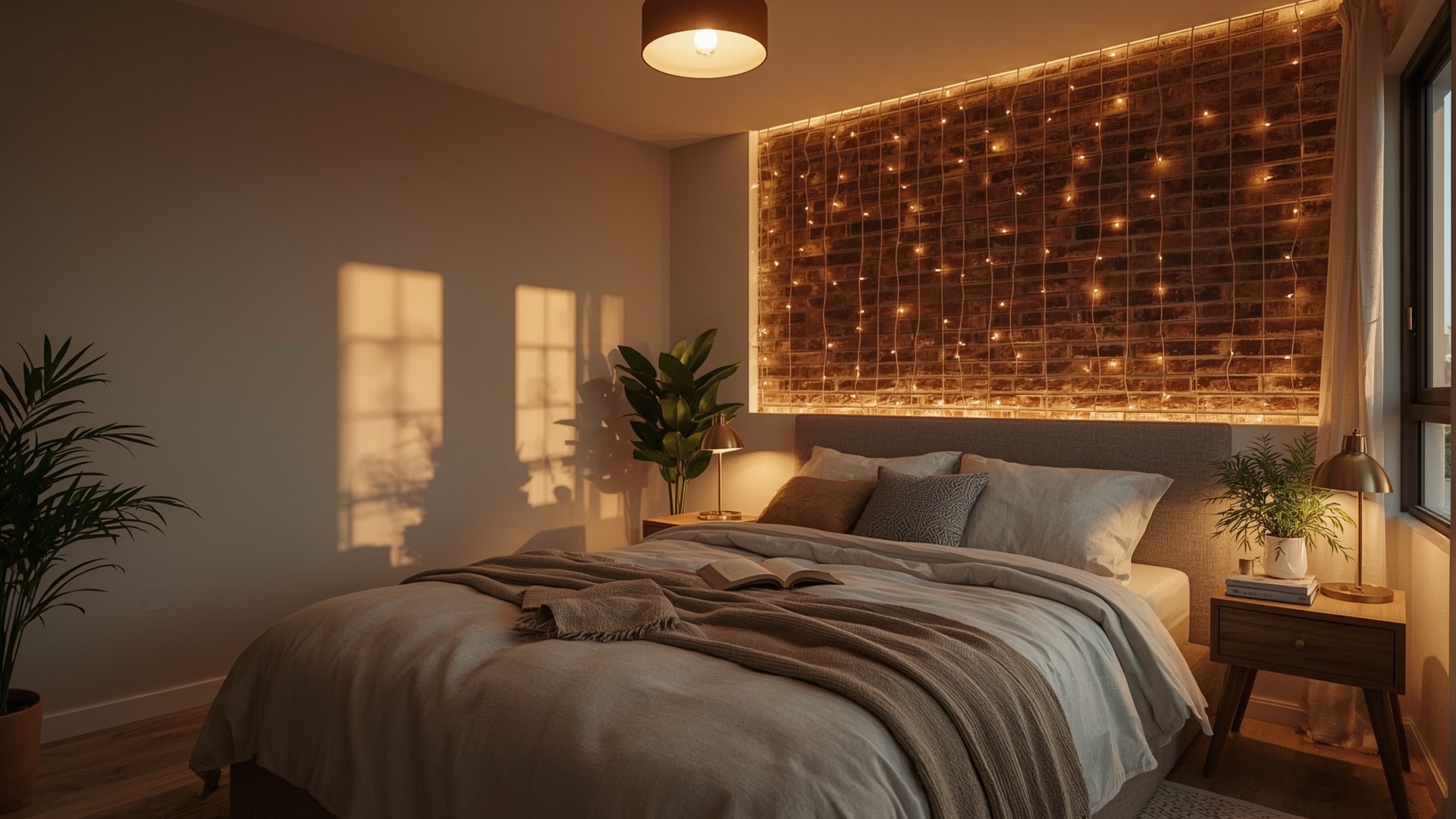
Your bedroom lighting does more than help you see. It sets the mood, makes the room feel bigger or cozier, and can even affect how well you sleep. The good news? You don’t need a big renovation budget to get it right. Most of the best bedroom lighting upgrades cost under $50 and take less than an hour to set up.
This guide covers every type of bedroom lighting, where to place it, and which affordable fixtures work best for renters and homeowners alike.
Key Takeaways
- Layer your lighting. Ambient, task, and accent lighting work together to create a complete, comfortable bedroom.
- Swap bulbs first. Changing to warm-white LED bulbs (2700K–3000K) is the cheapest and fastest upgrade you can make.
- Plug-in fixtures are renter-friendly. Wall sconces, pendant lights, and floor lamps with plug-in cords require zero wiring changes.
- Smart bulbs add flexibility. Dimmable smart bulbs let you shift from bright task lighting to soft evening light without buying new fixtures.
- Placement matters as much as the fixture. Even an inexpensive lamp can look intentional when positioned at the right height and distance.
- String lights and LED strip lights are the most affordable way to add accent lighting without any electrical work.
What Is the Best Type of Lighting for a Bedroom?
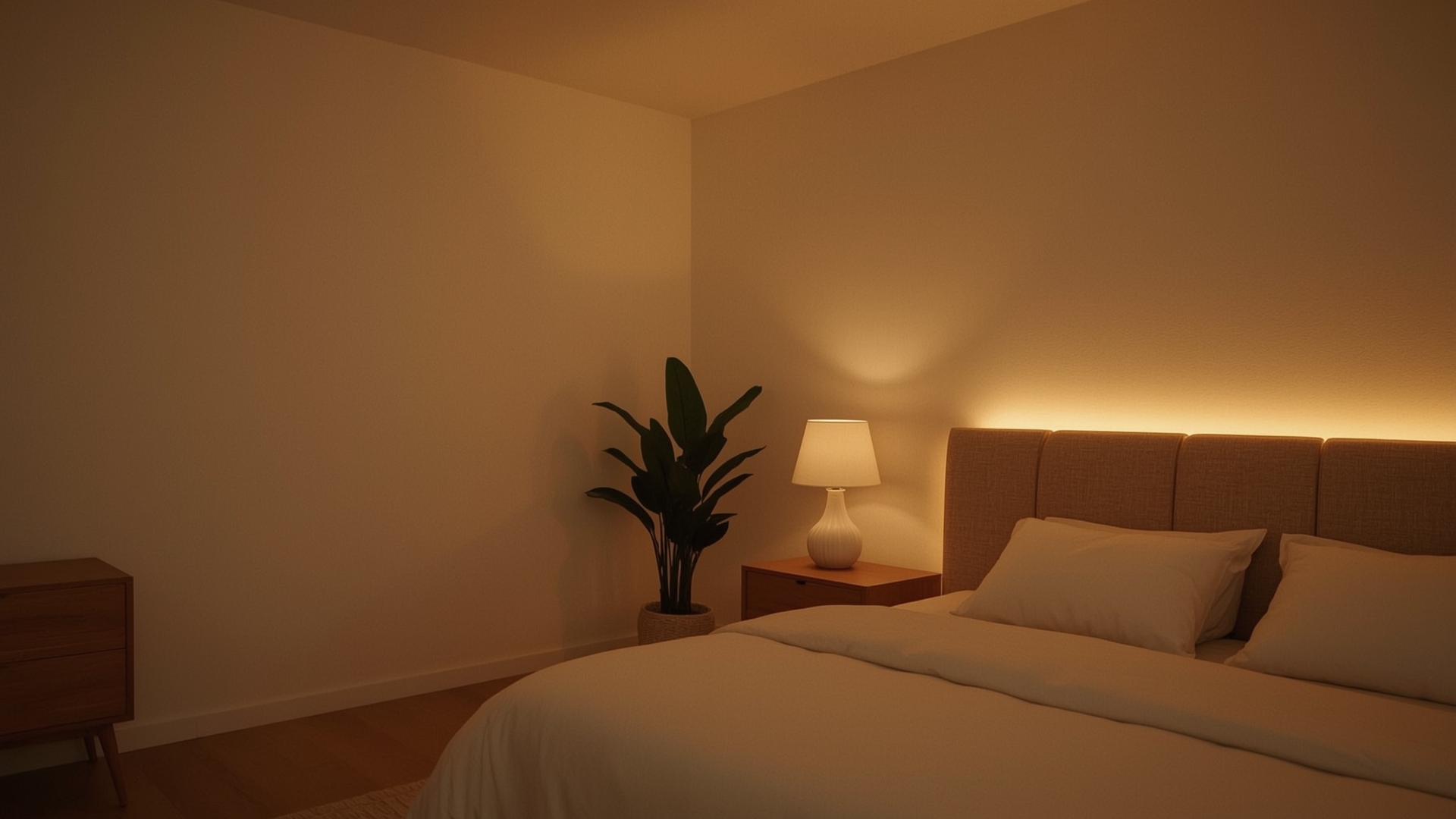
Quick Answer: The best bedroom lighting combines three layers: ambient light for overall brightness, task light for reading and getting dressed, and accent light for mood. No single fixture does all three. Using all three layers makes a bedroom feel intentional and comfortable.
Most bedrooms rely on one overhead light and call it done. That single fixture creates flat, harsh light that feels more like a waiting room than a place to rest. The fix is a layered lighting approach.
Ambient Lighting: Your Room’s Base Layer
Ambient lighting is your room’s general illumination. It fills the whole space and lets you see clearly. In most bedrooms, this comes from an overhead ceiling fixture or a ceiling fan with a light kit.
If your overhead fixture is fixed and boring, swapping the bulb is the cheapest upgrade. A warm-white LED bulb with a color temperature of 2700K to 3000K creates a softer glow than the standard cool-white bulbs most builders install.
Task Lighting: Where Focused Light Matters
Task lighting points at a specific activity. Beside your bed for reading. On your vanity or dresser for getting ready. At a desk if your bedroom doubles as a workspace. Task lighting should be bright enough to work without straining your eyes but positioned so it doesn’t shine directly in your face.
Accent Lighting: Mood and Depth
Accent lighting highlights specific areas or objects. Think of LED strip lights behind a headboard, string lights draped across a wall, or a small lamp aimed at a plant or piece of art. Accent lighting adds depth. It makes a flat room look layered without any structural changes.
How Do You Layer Bedroom Lighting on a Small Budget?
Quick Answer: Start with one good ambient source, add a bedside lamp for task light, then layer in accent lighting with LED strips or string lights. You can build a complete three-layer lighting setup in most bedrooms for under $80 total.
The key is to build the layers one at a time. You don’t need everything at once. Most people already have an overhead light, so ambient is covered. From there, a single bedside lamp adds task lighting for around $20 to $40. Then string lights or LED strip lights add accent lighting for as little as $10 to $20.
Budget Lighting Setup by Layer
| Lighting Layer | Fixture Type | Avg. Cost | Best For | Renter Friendly? |
|---|---|---|---|---|
| Ambient | Ceiling fixture / fan with light | $0–$60 | Full-room visibility | Yes (bulb swap only) |
| Ambient | Floor lamp (torchiere style) | $25–$55 | Rooms without overhead light | Yes |
| Task | Bedside table lamp | $15–$45 | Nighttime reading | Yes |
| Task | Clip-on reading light | $10–$25 | Headboards, desks, shelves | Yes |
| Accent | LED strip lights | $10–$30 | Behind headboards, under beds | Yes |
| Accent | String lights / fairy lights | $8–$20 | Wall displays, canopy frames | Yes |
What Are the Best Affordable Bedroom Light Fixtures?
Quick Answer: The best affordable bedroom fixtures include plug-in wall sconces ($20–$50), torchiere floor lamps ($25–$55), and clip-on reading lights ($10–$25). These fixtures require no wiring and work in any bedroom, including rentals.
Plug-In Wall Sconces
Wall sconces look built-in but many come with a plug-in cord. You mount them on the wall with a few small screws and plug them into a standard outlet. They free up nightstand space and place light exactly at eye level when you’re sitting up in bed. Prices range from $20 to $50 per sconce at most home goods stores.
Torchiere Floor Lamps
A torchiere lamp points upward and bounces light off the ceiling. This creates a soft, diffused glow that mimics natural ambient light better than a bare bulb overhead. These are especially useful in bedrooms without overhead lighting, which is common in older apartments. Many styles retail for $25 to $55.
Clip-On Reading Lights
Clip-on lights attach to headboards, shelves, or bed frames without any drilling. They’re the most flexible task lighting option and easily the most renter-friendly. USB-powered and battery-operated versions eliminate cords entirely. Good clip-on models cost $10 to $25.
LED Strip Lights
LED strip lights use adhesive backing to stick directly to surfaces. Common placements include behind a headboard, under a bed frame, along the top of a wardrobe, or around a mirror. Most kits come with a remote for color and brightness control. A quality 16-foot LED strip kit typically costs $10 to $30.
Affordable Bedroom Fixture Comparison
| Fixture | Price Range | Installation | Wiring Required | Best Placement |
|---|---|---|---|---|
| Plug-in wall sconce | $20–$50 each | 2–3 small screws | No | Both sides of headboard |
| Torchiere floor lamp | $25–$55 | None (plug in) | No | Corner near bed or seating |
| Bedside table lamp | $15–$45 | None (plug in) | No | Nightstand, 18–24″ from mattress top |
| Clip-on reading light | $10–$25 | Clip attachment | No | Headboard or bookshelf |
| LED strip lights | $10–$30 | Peel-and-stick | No | Behind headboard, under bed frame |
| String lights | $8–$20 | Hooks or clips | No | Wall canopy, window frame, shelving |
How Do You Light a Bedroom Without Overhead Lighting?
Quick Answer: Use a torchiere floor lamp in one corner for ambient light, add plug-in wall sconces beside the bed for task light, and place LED strip lights or string lights for accent depth. This three-source approach replaces overhead lighting without any electrical work.
Many apartments and older homes have bedrooms with no ceiling light at all. The room only has wall outlets. This is more common than people think, and it’s completely workable with the right approach.
No-Overhead Lighting Setup
- Place a torchiere floor lamp in one corner. Aim it toward the ceiling. This bounces soft ambient light across the whole room.
- Add plug-in wall sconces on either side of the bed. These replace overhead-style task lighting without touching the ceiling.
- Use LED strip lights behind the headboard. They add warmth and dimension, making the room feel complete despite having no ceiling fixture.
- Add a small table lamp on your dresser. A second light source in a different zone breaks up the room visually and prevents any one area from feeling dark.
What Color Temperature Should Bedroom Lights Be?
Quick Answer: Bedroom lights should be 2700K to 3000K, which is warm white. This range mimics candlelight and incandescent bulbs. It helps your brain wind down at night. Avoid anything above 4000K in a bedroom — that’s the cool, blue-white light used in offices.
Color temperature is measured in Kelvins (K). Lower numbers mean warmer, more orange light. Higher numbers mean cooler, more blue light. For bedrooms, you want to stay in the warm range.
LED Bulb Color Temperature Guide
| Color Temperature | Light Appearance | Best Room Use | Effect on Sleep |
|---|---|---|---|
| 2700K | Warm white / soft amber | Bedrooms, living rooms | Supports melatonin production |
| 3000K | Warm white / slightly neutral | Bedrooms, bathrooms | Minimal sleep disruption |
| 3500K | Neutral white | Kitchens, hallways | Slight alerting effect |
| 4000K | Cool white | Offices, garages | Reduces melatonin |
| 5000K–6500K | Daylight / bright blue-white | Task lighting, workshops | Strong alerting effect |
Are Smart Bulbs Worth It for a Budget Bedroom Lighting Setup?
Quick Answer: Yes. Smart bulbs like Philips Hue White or IKEA TRÅDFRI start around $10 to $15 per bulb and let you adjust brightness and color temperature without buying new fixtures. One smart bulb in your main lamp gives you full lighting control for about the price of a takeout meal.
Smart bulbs are one of the best value upgrades in a budget bedroom. You screw them into any standard bulb socket, connect them to your phone, and then you can dim them, change their warmth, or set them on schedules. No new fixtures. No wiring. No tools.
Why Dimming Matters for Bedrooms
Bright light in the evening tells your brain to stay awake. Dimming your bedroom light an hour before bed signals that it’s time to wind down. Smart bulbs make this easy with scheduled dimming. But even a standard dimmable LED bulb ($5 to $8) in a dimmer-compatible socket achieves the same result for less money.
Budget Smart Bulb Options
| Brand | Bulb Type | Price Per Bulb | Hub Required? | Color Temp Range |
|---|---|---|---|---|
| Philips Hue White | A19 LED | $13–$15 | Optional (bridge) | 2700K |
| IKEA TRÅDFRI | A19 LED | $10–$12 | Yes (DIRIGERA hub) | 2700K–4000K |
| Wyze Bulb Color | A19 LED | $10–$14 | No (Wi-Fi direct) | 2700K–6500K |
| Kasa Smart (TP-Link) | A19 LED | $8–$12 | No (Wi-Fi direct) | 2500K–6500K |
Where Should You Place Lamps in a Bedroom?
Quick Answer: Bedside lamps work best when the bottom of the shade sits at shoulder height when you’re sitting up in bed, roughly 18 to 24 inches above the mattress surface. Floor lamps look best in corners or beside furniture, never in the middle of a walkway.
Placement is where most people get bedroom lighting wrong. Even expensive fixtures look awkward when placed at the wrong height or in the wrong spot. A $25 lamp in the right position will outperform a $150 lamp shoved in the wrong corner.
Bedside Lamp Placement
The shade’s bottom edge should land at your shoulder level when sitting up in bed. This keeps the light at the right angle for reading without shining in your eyes. If your lamp is too tall, the glare is uncomfortable. Too short, and the light doesn’t reach your book or phone.
Floor Lamp Placement
Place floor lamps in corners or behind chairs and sofas. Corners maximize how far the light spreads. Avoid placing floor lamps behind you when reading — that creates an awkward shadow on your page. Position the lamp so it’s slightly in front and to the side of where you sit or lie.
LED Strip Light Placement
The most popular spot is behind the headboard, mounted along the top or sides. This creates a glowing halo effect that works as both ambient and accent lighting. Other effective placements include under the bed frame (creates a floating bed effect), along the top of a wardrobe, and around a vanity mirror.
What Bedroom Lighting Ideas Work Best for Renters?
Quick Answer: Renters should use plug-in fixtures, command hooks, adhesive LED strips, and clip-on lights. These options require no drilling beyond small picture-hanging holes and leave no permanent marks. Every fixture listed here can move out with you when you leave.
Renters face one main constraint: no permanent changes. That rules out hardwired fixtures, ceiling medallions with new wiring, and anything that requires significant wall damage. But it leaves a huge range of options.
Renter-Friendly Lighting Rules
- Plug-in only. If it doesn’t plug into a standard wall outlet, skip it unless installation is fully reversible.
- Adhesive strips with a weight limit. Command strips hold up to 16 lbs depending on the strip size. Use them for string lights, hooks, and lightweight sconce mounting plates.
- Peel-and-stick LED strips. These leave minimal residue on smooth surfaces. Test on a small hidden area first if your walls are painted flat instead of eggshell or satin.
- Cord management matters. Use adhesive cable clips to run lamp cords along baseboards. It looks intentional and keeps things safe.
How Can You Use String Lights to Improve Bedroom Ambiance?
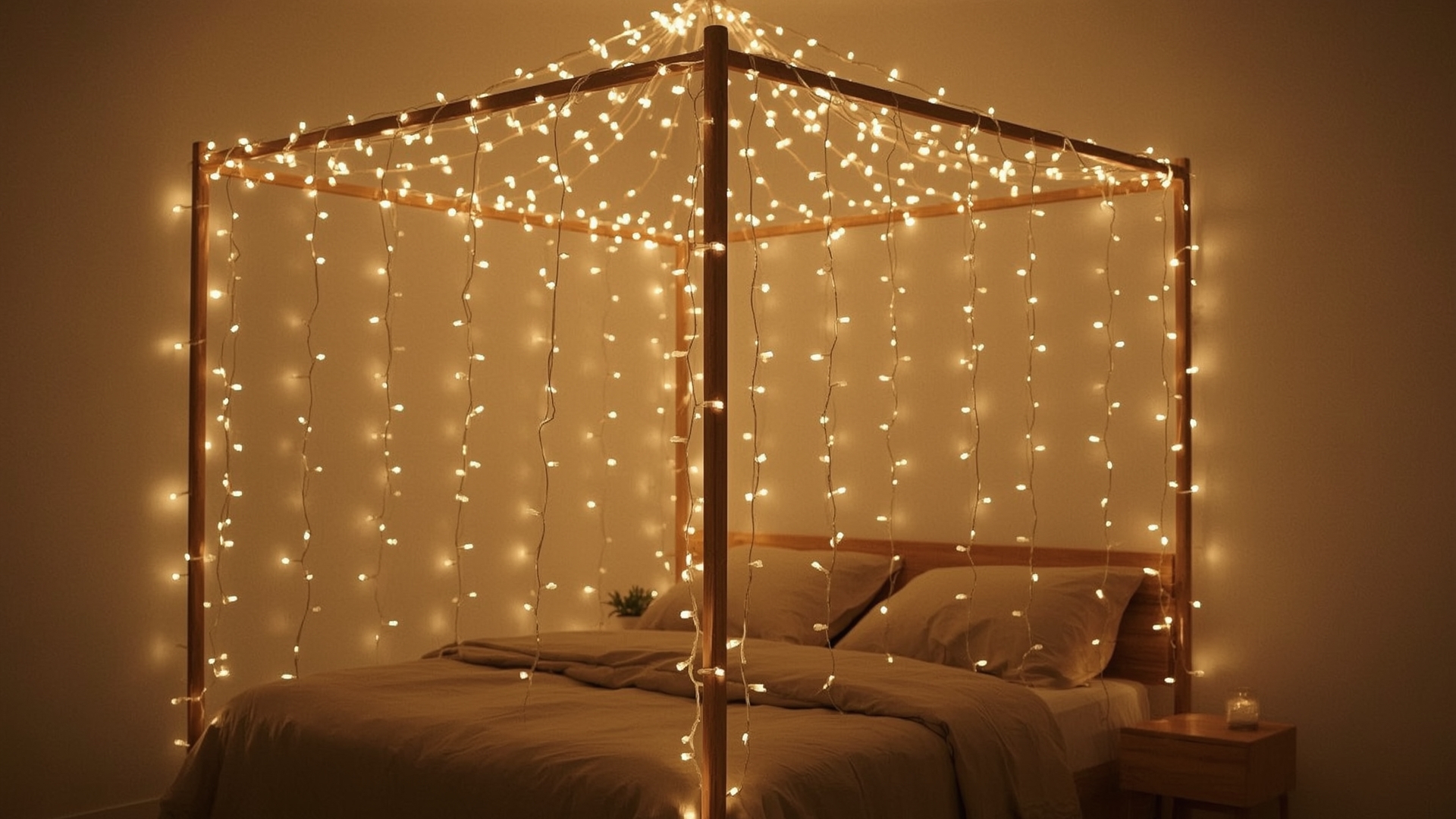
Quick Answer: String lights work best when draped over a canopy frame above the bed, zigzagged across one feature wall, or wrapped around a headboard. Warm white string lights at 2700K create a soft glow that functions as ambient accent lighting. Avoid cool-white or multicolor strings in a sleep space.
String lights are the most affordable accent lighting option available. A good 33-foot strand of warm-white fairy lights costs $10 to $20 and can transform an entire wall. The trick is placement — string lights need to be used with intention, not just tossed over a bed frame.
String Light Bedroom Ideas
- Canopy bed effect. Run four strands from a central ceiling hook down to the bedposts or floor. This creates a soft, tent-like canopy without a real canopy bed frame.
- Gallery wall backlight. Hang string lights behind or around a gallery wall of photos or art. The warm glow makes the display look purposeful.
- Headboard frame. Wrap string lights around a simple wooden or metal headboard to add warmth to a plain frame.
- Window frame border. Outline your window with a strand of fairy lights. At night, this creates a soft interior glow that makes the window a focal point.
What Lighting Changes Make a Small Bedroom Look Bigger?
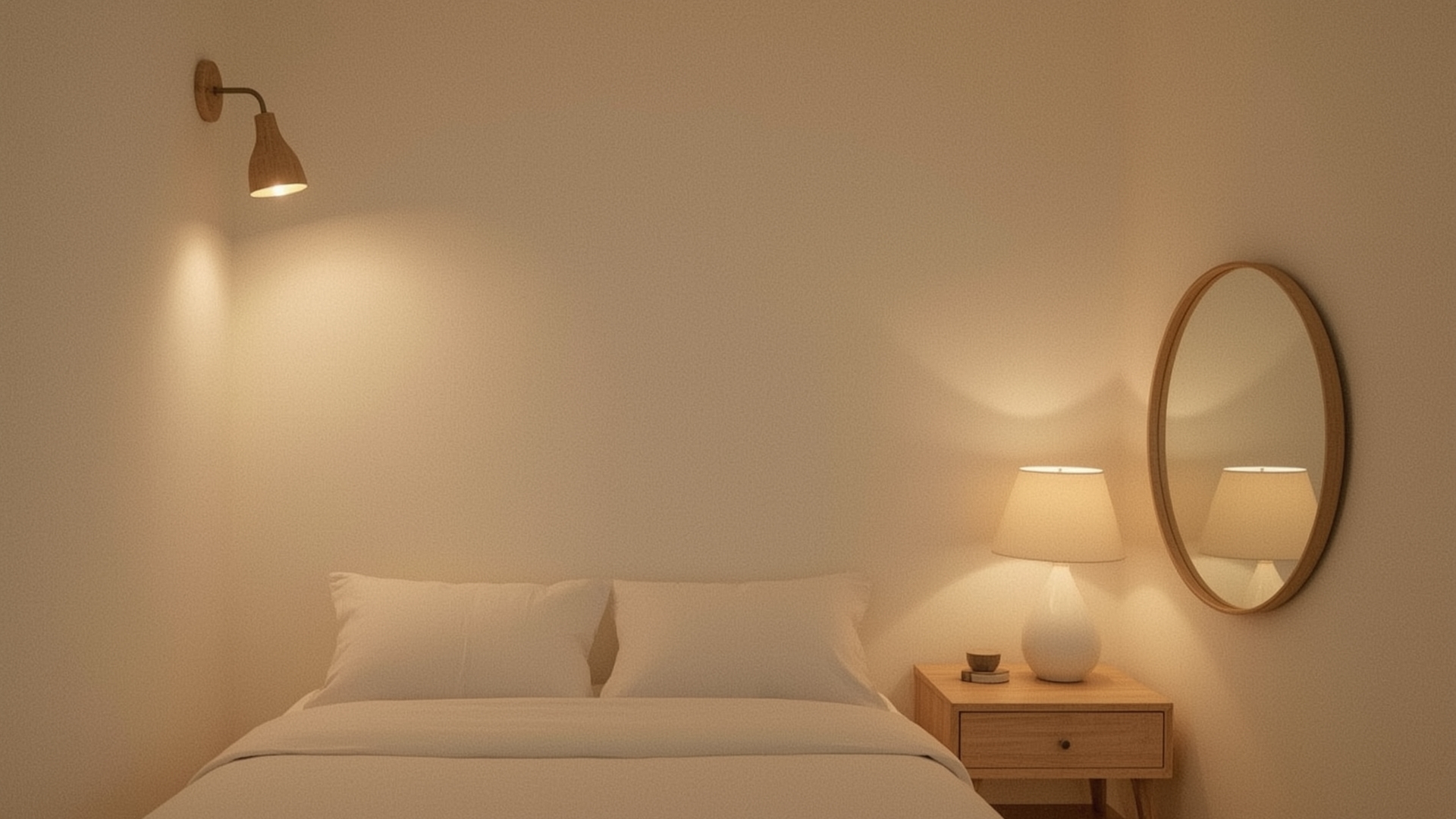
Quick Answer: Uplighting (pointing light toward the ceiling), mirrors placed opposite light sources, and LED strips along the floor or baseboards all make a small bedroom feel larger. Avoid heavy lampshades and low-hanging pendant lights, which visually compress the ceiling height.
Light and space perception are directly connected. Bright upper areas make ceilings feel higher. Light near the floor anchors the space and makes walls feel farther apart. A few simple lighting tricks can make a 10×10 room feel noticeably more open.
Small Bedroom Lighting Tricks
- Use uplighting in corners. A small uplight or upward-facing sconce in a corner draws the eye up and makes the ceiling feel taller.
- Place a lamp near a mirror. The mirror doubles the visible light in the room. Position any lamp or sconce so its light source reflects directly in the mirror.
- Use multiple lower-wattage sources. One bright overhead light creates a single harsh pool. Three smaller light sources spread evenly feel more spacious and balanced.
- Keep window areas bright. Never block natural light with heavy curtains during the day. Natural light is always the best and cheapest lighting upgrade.
How Do You Choose the Right Lamp Shade for a Budget Bedroom?
Quick Answer: White or cream lamp shades emit the most light and work with every decor style. Drum shades (straight sides, equal top and bottom diameter) spread light evenly. Empire shades (wider at the bottom) direct more light downward, making them better for task lighting beside a bed.
The shade shapes how light moves through a room. Dark or heavily patterned shades absorb light and create a moodier effect. Light, translucent shades spread brightness. For a small bedroom on a budget, a white drum shade or a white empire shade does the most work for the least money.
Lamp Shade Types and Their Effect
| Shade Style | Light Direction | Best Use Case | Price Range |
|---|---|---|---|
| Drum (white/cream) | All-directional, diffused | General ambient beside bed | $10–$30 |
| Empire (white/cream) | Downward focused | Task lighting for reading | $8–$25 |
| Drum (dark color) | Down and slightly outward | Mood / accent lamp | $12–$35 |
| Open top / bell | Up and down | Rooms needing more ceiling bounce | $10–$30 |
What Are the Best Bedroom Lighting Ideas for a Relaxing Atmosphere?
Quick Answer: Combine warm-white LED bulbs at 2700K, dimmable fixtures, and accent lighting from LED strips or candles to create a relaxing bedroom atmosphere. The goal is low, warm, layered light — bright enough to move safely, soft enough to feel restful.
A relaxing bedroom isn’t about dim for the sake of dim. It’s about the right kind of light in the right places. Your main ambient light should be dimmable. Your accent lighting should be warm. Your task light near the bed should point at what you’re doing, not at your face.
Relaxing Bedroom Lighting Checklist
- All bulbs at 2700K to 3000K warm white
- At least one dimmable light source
- No bare overhead bulbs (always use a shade or diffuser)
- LED strip lights or string lights for soft accent glow
- Blackout curtains to control outside light at night
- No blue-white or cool-white bulbs anywhere in the room
Frequently Asked Questions
Can you add a ceiling light to a bedroom without an electrician?
Yes, in many cases. Plug-in pendant lights hang from a ceiling hook and run a cord down the wall to an outlet. They look like hardwired pendants but require no electrical work. Swag-style pendant lights are the most popular version of this approach and cost $20 to $60.
What is the cheapest way to upgrade bedroom lighting?
Swapping your existing bulbs to warm-white LED bulbs at 2700K is the cheapest single upgrade. A pack of four LED bulbs costs $8 to $12. The color change alone makes most bedrooms feel noticeably warmer and more relaxing.
Are LED strip lights safe to leave on overnight?
Quality LED strip lights from established brands are designed to run for extended periods safely. However, it’s best practice to turn them off or set them on a timer overnight. Most LED strip kits include a remote with a timer function. Avoid cheap, uncertified strips with no safety markings.
How many lumens does a bedroom need?
A typical bedroom needs 10 to 20 lumens per square foot for general lighting. A 150-square-foot bedroom needs roughly 1,500 to 3,000 lumens total across all light sources. This doesn’t mean one 3,000-lumen bulb — multiple lower-lumen sources spread across the room work better for comfort.
What is a plug-in swag light?
A swag light is a pendant or chandelier-style fixture that hangs from a ceiling hook and has a visible cord that runs to a wall outlet. It creates the look of a hardwired ceiling fixture without any electrical installation. Swag lights are renter-approved and widely available for $20 to $70.
Do dimmer switches work with LED bulbs?
Yes, but only if both the switch and bulb are dimmable. Look for LED bulbs labeled “dimmable” on the packaging. Pair them with a compatible LED dimmer switch, not a standard incandescent dimmer. Many dimmable LED bulbs work fine with standard LED-compatible dimmer switches, which cost $15 to $25 to install.