Most cleaning advice assumes you have three uninterrupted hours and a quiet house. If you’re a mom, you know that’s not real life. Toys migrate back five minutes after you pick them up. Dishes reappear before you’ve dried your hands. And nap time disappears just when you finally sit down.
The fix isn’t cleaning harder. It’s building a routine that fits around your actual day. A few focused bursts of effort, spread across morning, afternoon, and evening, can keep your home consistently tidy without consuming your entire life. This guide shows you exactly how to do that.
Key Takeaways
- Time-blocking beats marathon cleaning sessions. Three 15-to-20-minute bursts a day outperform one long weekly clean.
- Morning routines set the tone. Just 15 minutes in the morning prevents afternoon overwhelm.
- Habit stacking makes cleaning automatic. Attach cleaning tasks to things you already do, like making coffee or starting school pickups.
- Zone cleaning reduces decision fatigue. Assign specific areas to specific times so you never wonder where to start.
- Kids can contribute from age two. Building age-appropriate tasks into their routines reduces your workload significantly.
- An evening reset takes 20 minutes or less. It’s what makes the next morning feel manageable instead of chaotic.
What Is a Daily Cleaning Routine for Moms?
Quick Answer: A daily cleaning routine for moms is a structured set of short cleaning tasks split across morning, afternoon, and evening. It uses 15-to-20-minute time blocks to maintain a tidy home without relying on long, exhausting deep-cleaning sessions.
A daily routine is different from a deep clean. Deep cleaning happens once a week or once a month. A daily routine is lighter. It maintains the baseline so things never spiral out of control.
Think of it like brushing your teeth. You don’t scrub them for an hour once a week. You spend two minutes twice a day, and that’s enough to keep them healthy. A daily cleaning routine works the same way.
The goal is a home that’s consistently “good enough” without you spending your whole day cleaning it.
Why Do Most Cleaning Routines Fail for Moms?
Quick Answer: Most cleaning routines fail because they’re designed for people without kids. They assume uninterrupted time, consistent energy, and predictable days. Moms need routines built around interruptions, not despite them.
The biggest mistake is building a routine that requires perfect conditions. If your routine only works when the kids are napping and you have energy, it’ll fall apart most days.
The second mistake is all-or-nothing thinking. Skipping the afternoon block doesn’t mean the day is ruined. It just means you do a slightly longer evening reset. Flexibility is a feature, not a flaw.
The third mistake is trying to do too much. A realistic daily routine covers maintenance, not perfection. You are not staging your home for a photoshoot every day.
How Should You Structure a Morning Cleaning Routine?

Quick Answer: A morning cleaning routine should take 15 to 20 minutes and focus on three areas: kitchen, beds, and a quick bathroom wipe-down. These tasks reset the home from overnight and prevent mess from building up before noon.
What to Do in the First 15 Minutes After Waking Up
The morning routine works best when it runs alongside things you’re already doing. You’re making coffee anyway. Wipe the counter while it brews. You’re in the bathroom anyway. Spray the sink and wipe it down while the kids brush their teeth.
This is called habit stacking. You attach a small cleaning task to an existing habit so it requires less willpower to start.
Morning Cleaning Task List by Time
| Task | Time Needed | When to Do It | Why It Matters |
|---|---|---|---|
| Make beds | 3-5 minutes | Right after waking | Signals the room is “reset” and reduces visual clutter |
| Wipe kitchen counters | 2-3 minutes | While coffee brews | Prevents sticky buildup and starts the day clean |
| Load or unload dishwasher | 3-5 minutes | During breakfast | Clears sink for the day so dishes don’t pile up |
| Quick bathroom wipe | 2-3 minutes | During kids’ brushing time | Keeps sink and mirror presentable daily |
| Sweep or Roomba start | 1-2 minutes | Before school drop-off | Picks up breakfast crumbs before they attract pests |
Should You Clean Before or After School Drop-Off?
Before drop-off works better for most moms. The house is quieter after everyone leaves, and returning to an already-started clean feels easier than starting from scratch.
That said, if mornings are chaos, do your morning tasks when kids leave. Five minutes after they’re out the door still counts as a morning routine.
What Should an Afternoon Cleaning Block Cover?
Quick Answer: The afternoon block should take 10 to 15 minutes and focus on high-traffic areas like the living room, kitchen counters, and any rooms kids used after school. It prevents the evening from feeling overwhelming when everyone is tired.
How to Use Nap Time or After-School Time for Cleaning
For moms with young children, nap time is prime time. But don’t spend all of it cleaning. Use the first 10 to 15 minutes to handle the afternoon tasks, then protect the rest for yourself.
For school-age kids, the after-school rush brings new mess. A 5-minute pickup challenge with kids right when they walk in the door can reset the living room before homework starts.
Afternoon Cleaning EAV Table
| Zone | Task | Time Required | Frequency |
|---|---|---|---|
| Living Room | Toss pillows, fold blankets, clear surfaces | 5 minutes | Daily |
| Kitchen | Wipe stove, clear any lunch dishes | 3-4 minutes | Daily |
| Kids’ Rooms | Toys to bins, laundry off floor | 3-5 minutes (with kids) | Daily |
| Entryway | Shoes to rack, bags hung | 2 minutes | Daily |
| Laundry | Switch load or fold basket | 5-10 minutes | 3-5 days per week |
What Is the “One Load a Day” Laundry Method?
The one load a day method means you wash, dry, and fold one load of laundry every single day instead of doing five loads on the weekend. It takes about 10 minutes of active effort spread across the day.
This works because laundry never becomes a mountain. You’re always one day behind at most, not five. For families with three or more people, this method prevents laundry paralysis.
How Do You Build an Evening Reset Routine?

Quick Answer: An evening reset routine takes 15 to 20 minutes and runs after dinner. It covers dishes, kitchen wipe-down, a living room pickup, and laying out tomorrow’s essentials. It’s the single highest-impact habit for making mornings feel calm.
Why the Evening Reset Matters More Than Morning Cleaning
Waking up to a clean kitchen changes the entire tone of your morning. When the sink is empty and the counters are clear, you start the day with a sense of control. When it’s a mess, the day feels like it’s already behind before it starts.
The evening reset isn’t about getting the house perfect. It’s about removing friction from tomorrow morning.
Evening Reset Task Sequence
- Clear and wipe the kitchen — 5 to 7 minutes. Load dishwasher, run it, wipe counters and stove top.
- Living room pickup — 3 to 5 minutes. Toys to bins, remotes in place, throw blankets folded.
- Kids’ rooms tidy — 3 to 5 minutes (kids help). Pajamas on, clothes in hamper, backpacks packed.
- Tomorrow prep — 2 to 3 minutes. Set out coffee mug, check the schedule, lay out your clothes.
- Quick floor sweep — 2 minutes. Catch dinner crumbs before they become tomorrow’s problem.
How to Get Kids Involved in the Evening Reset
Kids aged 2 and up can help with the evening reset. A 2-year-old can put toys in a bin. A 5-year-old can clear their plate. A 10-year-old can wipe the table. The key is making it non-negotiable and short enough that no one dreads it.
A 10-minute family cleanup before screen time works well for school-age kids. It builds the habit early and takes pressure off you.
What Is Time-Blocking for Cleaning and How Does It Work?
Quick Answer: Time-blocking for cleaning means assigning specific cleaning tasks to fixed time slots during the day. You set a 15-minute block in the morning, one in the afternoon, and one in the evening. Each block has a defined task list so there’s no deciding what to clean.
Time-blocking removes the biggest barrier to starting: the decision. When you don’t know where to begin, you often don’t begin at all.
A time block doesn’t need a timer, though a timer helps. Set 15 minutes on your phone and stop when it rings. You’ll be surprised how much you get done when the end is in sight.
Time-Blocking Schedule for Full-Time Moms
| Time Block | Duration | Focus Area | Key Tasks |
|---|---|---|---|
| Morning (7:00–7:20 AM) | 20 minutes | Kitchen + Bathrooms + Beds | Dishwasher, counter wipe, bed-making, sink wipe |
| Afternoon (1:00–1:15 PM) | 15 minutes | Living spaces + Laundry | Living room pickup, laundry switch, vacuum if needed |
| Evening (7:30–7:50 PM) | 20 minutes | Kitchen + Kids’ rooms + Reset | Dinner cleanup, toy bins, tomorrow prep |
Time-Blocking Schedule for Working Moms
| Time Block | Duration | Focus Area | Key Tasks |
|---|---|---|---|
| Morning (6:30–6:45 AM) | 15 minutes | Kitchen + Bathrooms | Dishwasher unload, counter wipe, quick bathroom spray |
| After work (5:30–5:40 PM) | 10 minutes | Entryway + Kitchen | Bags put away, prep dinner zone, clear surfaces |
| Evening (8:00–8:20 PM) | 20 minutes | Full reset | Dinner cleanup, toy bins, laundry fold, tomorrow prep |
How Can Habit Stacking Make Cleaning Easier?
Quick Answer: Habit stacking pairs a cleaning task with an existing daily habit. For example, wiping the bathroom sink while kids brush teeth, or tidying the living room while waiting for water to boil. It removes the need for extra motivation because you’re already doing the trigger habit.
Habit stacking comes from behavioral psychology. The idea is that established habits are easier to extend than new ones are to start. You’re borrowing momentum from something you already do automatically.
For moms, this is especially powerful because your day is already structured around the kids’ schedule. That schedule becomes your cleaning trigger system.
Habit Stacking Examples for Moms
- While coffee brews → wipe kitchen counters
- While kids brush teeth → wipe bathroom sink and mirror
- While waiting for school bus → tidy entryway
- While kids eat lunch → unload dishwasher
- While bath runs → spray and wipe the toilet
- While watching the evening news or a show → fold one load of laundry
- While kids do homework → sweep kitchen floor
Which Cleaning Tasks Should You Do Every Day vs. Weekly?
Quick Answer: Daily tasks include dishes, kitchen wipe-down, bed-making, and a quick bathroom spray. Weekly tasks include mopping, vacuuming carpets, scrubbing toilets, cleaning mirrors, and changing sheets. Mixing these up leads to burnout or an always-dirty home.
Daily vs. Weekly Cleaning Task EAV Table
| Task | Frequency | Time Required | Priority Level |
|---|---|---|---|
| Dishes / Dishwasher | Daily | 5-10 minutes | High |
| Kitchen counter wipe | Daily | 2-3 minutes | High |
| Bathroom sink wipe | Daily | 1-2 minutes | Medium-High |
| Bed-making | Daily | 3-5 minutes | Medium |
| Floor sweep (kitchen) | Daily | 2-3 minutes | Medium |
| Vacuum carpets | Weekly (1-2x) | 15-25 minutes | High |
| Mop floors | Weekly | 15-20 minutes | Medium |
| Scrub toilets | Weekly | 3-5 minutes per toilet | High |
| Change bed sheets | Weekly | 10-15 minutes per bed | High |
| Clean mirrors and glass | Weekly | 5-8 minutes | Low-Medium |
How Do You Build a Cleaning Routine That Actually Sticks?
Quick Answer: A cleaning routine sticks when it’s simple, consistent, and forgiving. Start with just two tasks per time block. Do them at the same time every day for 21 days. When those feel automatic, add one more task. Never try to overhaul everything at once.
The 21-Day Habit Formation Framework
Research in habit formation suggests it takes an average of 21 to 66 days to solidify a new habit. For cleaning routines, starting small dramatically improves your success rate.
Week one: pick just the morning block. Do two tasks. That’s it. Week two: add the evening reset. Week three: add the afternoon block. By week four, you have a full three-block routine that feels natural instead of forced.
What to Do When You Fall Off the Routine
You will miss days. Everyone does. The rule is simple: never miss twice in a row. One skipped day is a rest. Two skipped days becomes a habit of skipping.
When you miss a day, don’t try to compensate by doing double the next day. Just pick up exactly where you left off. The routine is a long-term system, not a daily performance review.
How to Adjust Your Routine for Different Life Stages
A routine that works for a mom with a newborn looks completely different from one for a mom with school-age kids. The structure (morning, afternoon, evening blocks) stays the same. The specific tasks and time lengths shift.
Newborn stage: reduce each block to 10 minutes. Focus only on the kitchen and one bathroom. Everything else waits. Toddler stage: involve the toddler in simple tasks like throwing trash away or putting shoes on the rack. School-age stage: kids take on defined tasks, and your blocks get shorter.
What Are the Best Cleaning Tools for a Faster Daily Routine?
Quick Answer: The best tools for a fast daily routine are a microfiber cloth, an all-purpose spray, a handheld vacuum, a dishwasher, and a robot vacuum. These reduce active cleaning time by 30 to 50 percent compared to using mops, sponges, and manual sweeping for every task.
Essential Daily Cleaning Tools EAV Table
| Tool | Use Case | Time Saved vs. Alternative | Approximate Cost |
|---|---|---|---|
| Microfiber cloths | Counter wipes, mirror wipe, dusting | 2-3 minutes per surface | $8-$20 for a pack of 12 |
| All-purpose spray cleaner | Counters, sinks, stovetop | Eliminates scrubbing time | $3-$8 per bottle |
| Handheld vacuum | Crumbs, car seats, couch cushions | 5-10 minutes vs. full vacuum | $30-$80 |
| Robot vacuum (e.g., Roomba) | Daily floor maintenance | 15-20 minutes of active sweeping | $200-$500 |
| Dishwasher | All dishes and pots | 20-30 minutes of hand-washing | $400-$900 (appliance) |
| Laundry hampers by room | Prevents floor laundry buildup | 5-10 minutes of daily gathering | $15-$40 each |
How Do You Handle Cleaning With a Baby or Toddler at Home?
Quick Answer: With a baby or toddler at home, reduce your daily blocks to 10 minutes each and focus only on safety-critical areas like the kitchen and one bathroom. Use nap windows strategically and accept that visual clutter is temporary, not failure.
Babies and toddlers are chaos agents. They work faster than you do and have zero regard for your systems. The goal during these years is survival-level maintenance, not a spotless home.
During the baby stage, the only non-negotiable tasks are kitchen hygiene (dishes, counters, high chair wipe) and one bathroom. Everything else is optional.
As your child hits 18 months to 2 years, they can start participating. Give them a small spray bottle filled with water and a cloth. Let them “clean” alongside you. It’s mostly adorable and slightly useful.
How Do You Involve Kids in the Daily Cleaning Routine?
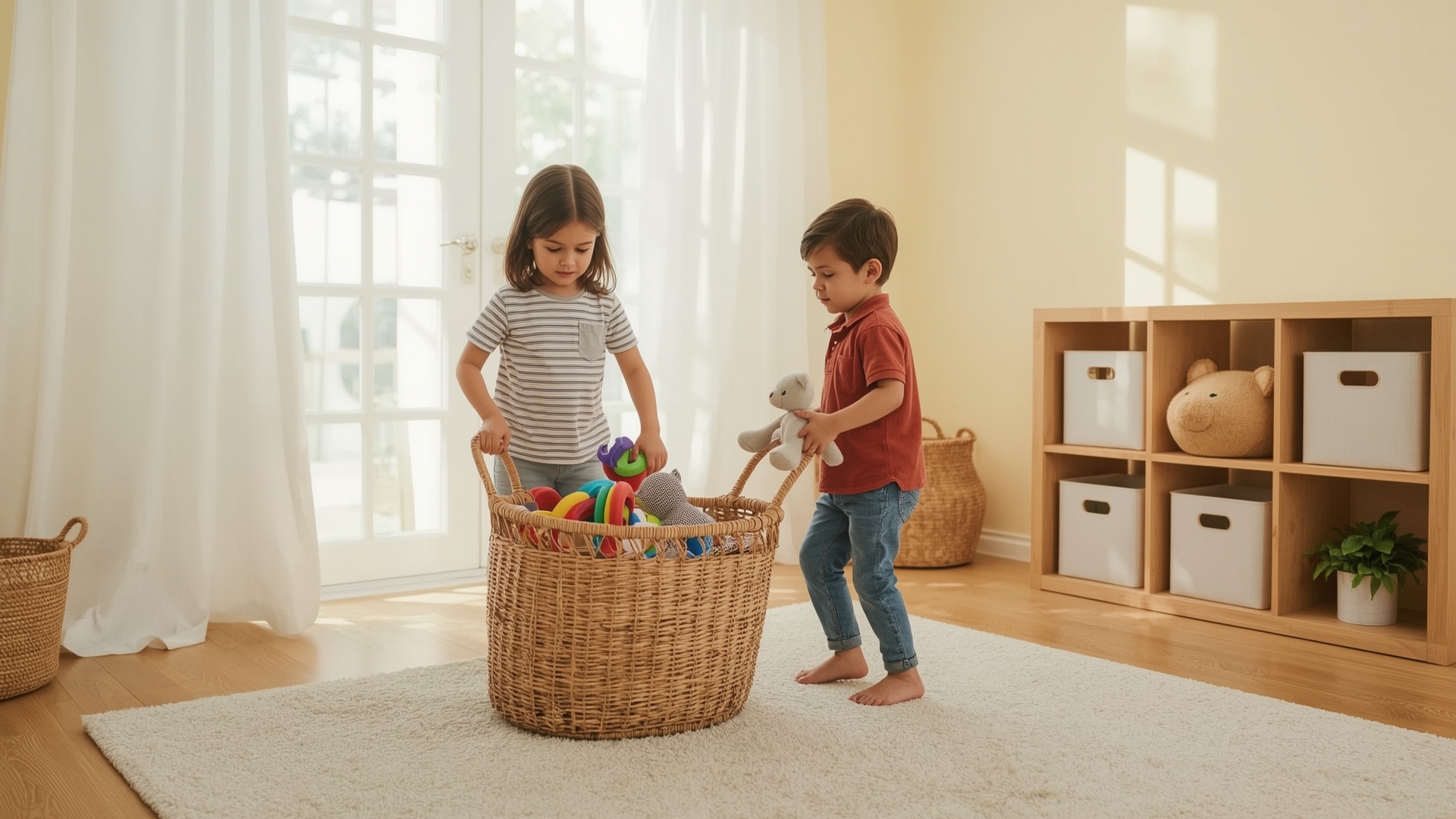
Quick Answer: Kids can contribute to daily cleaning from age two with simple tasks like putting toys in bins or throwing away trash. By age six, they can wipe surfaces and set the table. By age ten, they can handle a full zone of the house independently for 10 minutes a day.
Age-Appropriate Daily Tasks for Kids
- Ages 2-3: Put toys in bins, throw trash in wastebasket, carry their plate to the sink
- Ages 4-5: Make their bed (imperfectly), feed pets, wipe their place at the table
- Ages 6-8: Load silverware into dishwasher, dust low surfaces, clear the table, fold washcloths
- Ages 9-11: Vacuum their room, clean their bathroom sink, sweep the kitchen, fold laundry
- Ages 12+: Full room responsibility, mop a zone, start and switch laundry, clean a bathroom completely
The goal isn’t a perfect job. The goal is a built-in habit and real contribution. A slightly imperfect bed made by a 5-year-old is better than a perfect bed made entirely by you every day for the next six years.
What Is the Minimum Viable Cleaning Routine for Overwhelming Days?
Quick Answer: On overwhelming days, the minimum viable routine is just three tasks: clear the kitchen sink, do one sweep of the living room, and wipe the bathroom sink. These three tasks take under 10 minutes and prevent the worst visual chaos from compounding.
Every mom has days where the full routine isn’t possible. Sick kids, bad nights, hard days. You need a fallback.
The minimum viable routine is your baseline. It’s what you do when everything else falls apart. Three tasks, 10 minutes, done. Tomorrow you pick up the full routine again.
If even three tasks feel like too much, pick one: the kitchen. A clean kitchen sink signals order even when the rest of the house doesn’t. It’s the one task that has the highest psychological impact per minute of effort.
Frequently Asked Questions
How long should a daily cleaning routine take for a mom?
A realistic daily cleaning routine takes 45 to 60 minutes total, split across three blocks of 15 to 20 minutes each. This includes morning, afternoon, and evening tasks. On busy days, it can shrink to 20 to 30 minutes using a minimum viable routine.
What is the most important cleaning task to do every single day?
The kitchen is the most important area to clean daily. Dirty dishes and food residue attract pests and create hygiene risks. A clean kitchen also has a strong psychological effect, making the whole home feel more manageable even if other rooms are messy.
How do stay-at-home moms keep the house clean with kids around?
Stay-at-home moms keep the house clean by using short time blocks rather than long cleaning sessions. Involving kids in age-appropriate tasks, using habit stacking, and accepting “good enough” rather than perfect are the three most effective strategies. A 20-minute morning block and a 20-minute evening reset handle most of the daily maintenance.
What is a zone cleaning system and should moms use it?
Zone cleaning divides your home into specific areas, like kitchen, bathrooms, bedrooms, and living spaces. Each day or time block focuses on one zone instead of trying to clean everything at once. This approach reduces overwhelm and works well for moms because it narrows decisions and keeps sessions short and focused.
Can a robot vacuum replace daily sweeping in a mom’s cleaning routine?
A robot vacuum handles daily floor maintenance effectively for most households. Models like the Roomba can be scheduled to run automatically while you handle other tasks. They work best on hard floors and low-pile carpet, but they don’t replace occasional deep vacuuming of high-pile carpet or stairs.
How do you clean the house when you have no motivation?
Start with just two minutes. Set a timer and pick one surface. Most of the time, starting is the hardest part, and you’ll continue past two minutes once you’re moving. If you truly can’t, default to the minimum viable routine: clear the kitchen sink, sweep the living room, and wipe the bathroom sink. That’s enough for a hard day.